Warehouse software
It reads the order. It does not run the warehouse.
The AI in Market Run has a few specific jobs: read what a kitchen typed, match it to a product, catch a voice note, pull a figure off an invoice, nudge tomorrow's buy. It never decides anything a person has not agreed to.
In Market Run, AI means Claude reads free-text WhatsApp orders into priced catalogue lines, matches a kitchen's own words to the right product, transcribes voice notes, and pulls figures from supplier invoices. It is not a robot, and it does not run the warehouse. A person still confirms anything it cannot place with confidence.
"AI-powered" is the most misused phrase in this category, so this page names exactly where it is, rather than slapping it on the whole product. It is in the reading, the matching, the transcribing and the pulling out of figures - the parts of the job that used to mean someone retyping what a customer already said. It is not in the driving, the picking, or the decision to deliver.
What the AI actually does
- 01Reading the order. Free text, a photo of a handwritten list, or a voice note, turned into catalogue lines against this wholesaler's own products.
- 02Matching the words. A kitchen's own word for a product is learned, then matched to the same catalogue line every time - not looked up in a fixed dictionary.
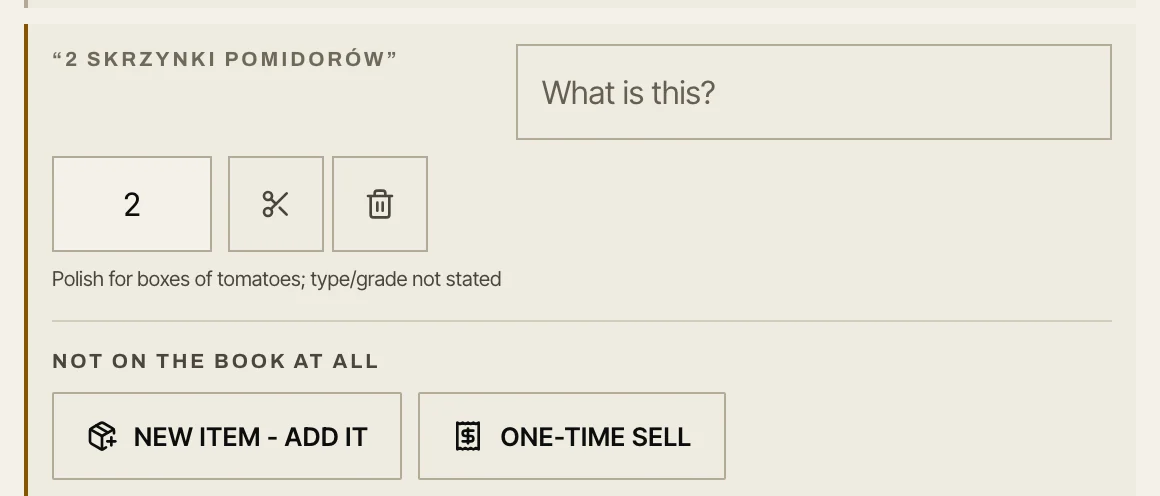
- 03Deciding what to trust. A match made with confidence is applied automatically. Anything less is held back for a person to name - never guessed.
- 04Reading a docket or invoice. A photo of a trader's market docket or a supplier invoice is read for cost, quantity and line, instead of retyped by hand.
- 05Adding a forecast buffer. The buy list adds what usually sells on top of what customers have confirmed, so buying is not only ever a reaction to what has arrived so far.
Held back and asked about, never guessed
One number that shows it working
One wholesaler's own book puts a number on this. Before the matching improved, its order desk faced 1,431 real questions a night - lines it could not place with confidence. It now faces 384. The AI did not close that gap alone: most of it comes from an automatic match above the confidence threshold, or a one-tap shortlist a person still approves. That is across 47,936 messages and 197,758 order lines read over four years.
Plainly
What it will not do on its own
- It never guesses a product it has not seen before. Anything below its confidence threshold is held for a person to name, every time.
- It does not run the warehouse on its own. A person still picks, drives and delivers. The AI reads and matches - it does not act.
- Automatic WhatsApp replies wait on Meta's approval. Sending the answer by hand works today.
- It does not listen to a phone call. Someone still types what was said before it can be matched.
- It never matches across a grade tier. Class II is never offered in place of Class I or Extra Class, confidence score or not.
Read next
Questions people ask
- What does 'AI' actually mean in Market Run?
- It means Claude reads free-text WhatsApp orders, photos of handwritten lists and voice notes into priced catalogue lines. It matches a kitchen's own words to the right product, pulls figures from supplier invoices and market dockets, and adds a forecast buffer to the day's buy. It is not a general assistant, and it does not control anything physical.
- Does the AI place orders on its own?
- No. It turns what a kitchen sent into priced order lines against the catalogue. A person still confirms anything it could not match with confidence. Nothing is delivered without a human step in between.
- Can it read a voice note or a photograph of a list?
- Yes. A voice note is transcribed, and a photo of a handwritten list is read. Both are matched against the catalogue the same way free text is, and both are traceable back to the original message.
- Does it forecast demand?
- It adds a forecast buffer to the day's buy list, based on what usually sells on top of what has been confirmed. That way a buyer is not only ever buying to what has arrived so far. It does not replace a buyer's own judgement on the day.
Give us one night.
Send us one evening's orders. We run the night next to you. In the morning you compare the two.