Features
Price setter
Sets the price on every order line, per customer, automatically. Never guessed from memory.
Price setter is the arrangement one customer gets against cost or list price: a fixed price, a markup, a discount, or a rate that follows the market. It is stored once against the catalogue and applied automatically to every order line. Nobody re-quotes it from memory.
Every wholesaler already runs different prices for different customers. The problem was never the pricing - it was that the arrangement lived in one buyer's head, or a spreadsheet nobody else opened. Price setter just means it is written down once and used the same way every time.
How it works
- 01Each customer's arrangement is set once: a fixed price, a percentage off a category, a markup on cost, or a rate that tracks the market.
- 02Every order line for that customer prices itself against the rule, the moment the order is read.
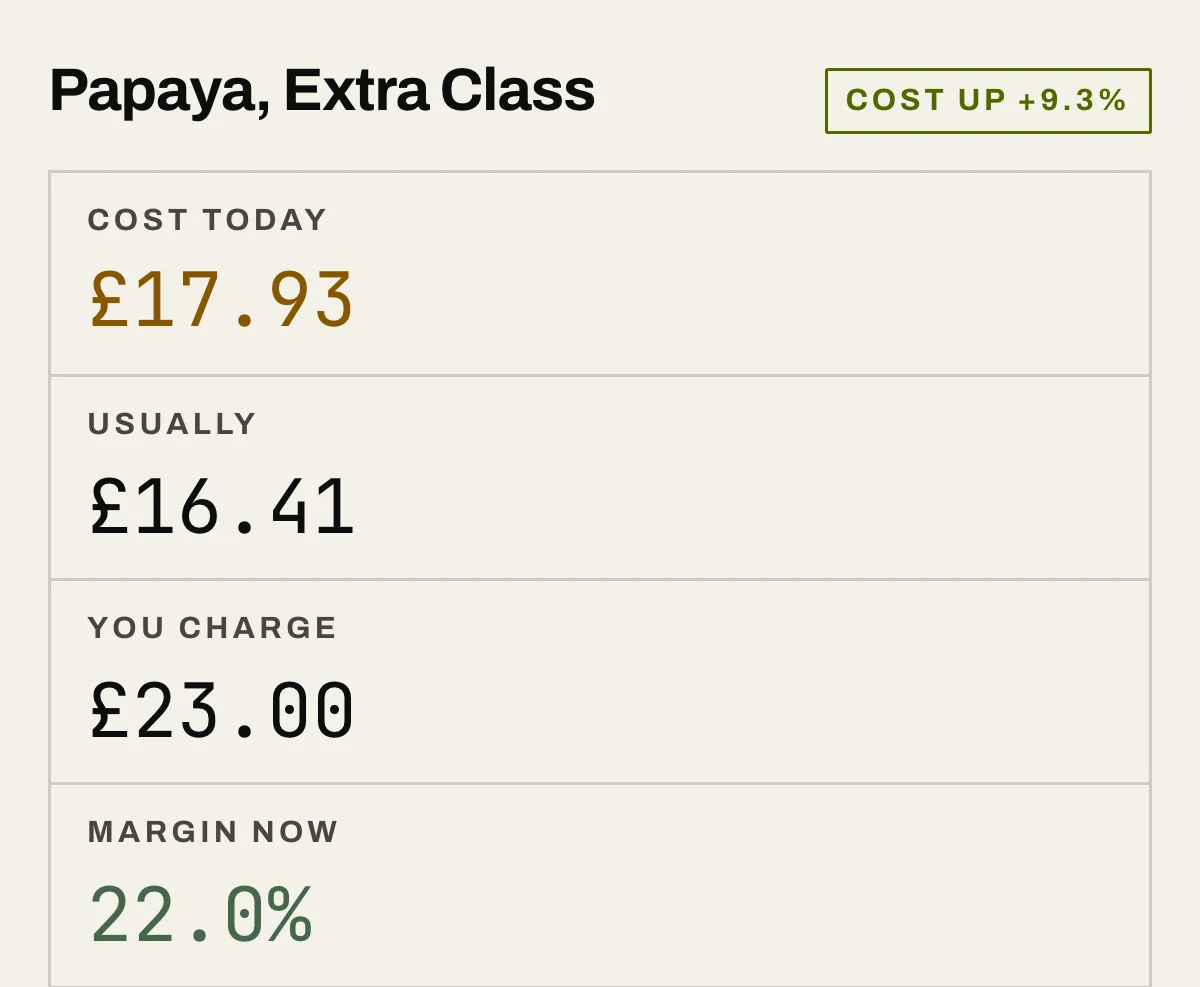
- 03If the cost behind a line moves, the price can be held or followed. That choice is a person's decision, not the software's.
- 04A price older than 48 hours is never shown as live. It is labelled, so nobody quotes yesterday's cost as today's.
- 05One wholesaler's own book held 317 pricing arrangements before this existed as software - most were in someone's head.
What one customer's line looks like
What it replaces
Price setter replaces a price list on paper, or a rule only one buyer remembers. No more working out, on every order, what this one customer pays. No more catching it after the invoice went out wrong.
What it works with
- Order takerEvery matched order line arrives ready to be priced. Nothing is typed in twice.
- Margin watchShows what holding or following a moved cost does to the margin on this price.
- Invoice runnerThe price set here is the price that lands on the invoice.
Plainly
What it will not do on its own
- It does not invent a price for a customer with no arrangement. It asks for one.
- It will not change what a customer is charged on its own. A person confirms a rule before it goes live.
- It does not set your prices for you. It holds the ones you already decided.
- A rate that tracks the market still needs a market price to track. It does not invent one that does not exist.
What it replaces
A price list on paper, or a rule only one buyer remembers.
Time it saves
The minutes spent, on every order, working out what this one customer pays - or catching it after the invoice went out wrong.
Questions people ask
- What is a pricing rule?
- A pricing rule is the arrangement one customer gets against cost or list price - a fixed price, a markup, a discount off a category, or a rate that moves with the market. It applies automatically to every order line for that customer.
- Can different customers pay different prices for the same product?
- Yes. That is normal for a wholesaler, and it is why a spreadsheet or memory breaks down. One wholesaler's own book held 317 different pricing arrangements.
- What happens if a supplier's cost goes up?
- The line is flagged as cost up. A person decides whether to hold the price or follow the cost. It is never changed without that decision.
- Does a price ever go stale?
- A price older than 48 hours is never shown as live. It is labelled as stale so nobody prices an order against a cost that has moved.
Give us one night.
Send us one evening's orders. We run the night next to you. In the morning you compare the two.