Features
Margin watch
Flags every line where cost has moved and shows what holding or following it does to the margin, automatically.
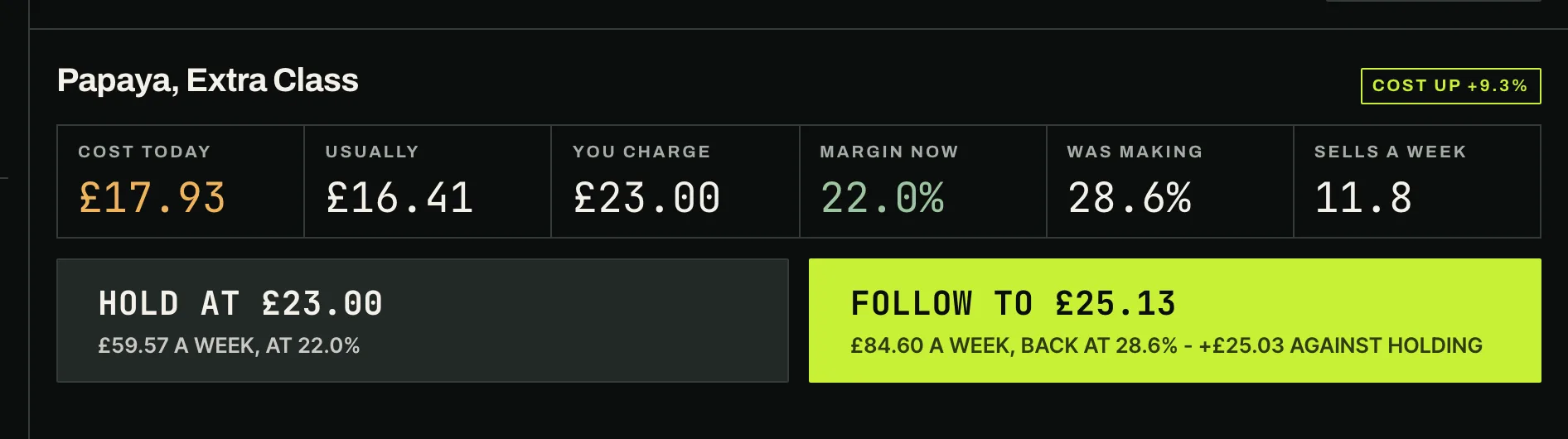
Margin watch compares what a product cost today against what a customer is charged, and shows whether the margin held, grew, or was quietly given away when a supplier's price moved. It flags every line where cost has changed and shows what holding or following that change would do to the margin.
A margin that erodes a percent at a time on one product, for one customer, never shows up as a single alarming number - it shows up as a slightly worse month, with no line to point at. Seeing it line by line, on the day cost moved, is the difference between a decision and a discovery three months later.
How it works
- 01Every product carries today's cost, the usual cost, and what each customer is charged, side by side.
- 02When a supplier's price moves, the line is flagged - cost up or down - the moment it is entered.
- 03Two numbers sit next to the flag: what holding the current price makes, and what following the cost change would make instead.
- 04A margin held quietly below where it should be shows up here before it shows up in the month-end numbers.
- 05The decision to hold or follow a price stays with a person. The software surfaces the choice, it does not make it.
What a flagged line looks like
What it replaces
Margin watch replaces finding out at month-end, from an accountant's report, that a margin had been quietly slipping for weeks. It is flagged on the day cost moved, not three months later.
What it works with
- Buy listThe cost behind every flag comes from what was actually paid at the market.
- Price setterShows what holding or following a moved cost does to the price already set.
- Growth numbersA margin worth acting on can feed straight into the week's numbers.
Plainly
What it will not do on its own
- It does not change a price on its own. Holding or following a cost move is a person's decision every time.
- It will not invent a margin target. It shows what a price is doing against the cost you actually paid.
- It does not analyse a supplier's price before you have logged it. A docket still has to be entered or photographed.
What it replaces
Finding out at month-end, from an accountant's report, that a margin had been quietly slipping for weeks.
Time it saves
The time spent, at month-end, working out which line went wrong and when. Seeing it flagged on the day cost moved is the same job, done before it becomes one.
Questions people ask
- What does margin watch actually show?
- It compares what a product cost today against what a customer is charged and shows whether the margin held, grew, or was given away when a supplier's price moved, line by line rather than as one average.
- Does it change prices automatically?
- No. It flags where cost has moved and shows what holding the price or following the cost would do to the margin - a person decides which.
- Can it show margin by customer, not just by product?
- Yes, because each customer's own price is already stored against the product, so the same view works either way.
- Where does the cost data come from?
- From what was actually paid - a trader's docket, photographed at the market, or a supplier invoice - not a price list that may be out of date.
Give us one night.
Send us one evening's orders. We run the night next to you. In the morning you compare the two.