Features
Invoice runner
Raises the invoice automatically from the proof of delivery, at the actual weight picked.
Invoice runner turns a delivered order into an invoice priced at what was actually picked and delivered, not what was ordered or a nominal weight. It raises the invoice from the proof of delivery, applies that customer's price, and puts catch-weight lines at their true weight. Nobody is billed until a person releases the day.
A box of fish or a side of beef is sold by the piece but priced by the kilo, and no two boxes weigh the same. Invoice runner uses the weight actually picked that day, never a nominal weight or an average. Getting this wrong loses margin silently, line by line, on every catch-weight product.
How it works
- 01The invoice is built from what was proved at the door, not from the original order line.
- 02Catch-weight lines carry the weight actually picked, never a nominal or averaged one.
- 03That customer's pricing rule applies at the moment of invoicing, using the cost and rate that were live that day.
- 04The invoice, the delivery note and the proof of delivery all link back to the same order, so a query never starts from nothing.
- 05Nobody is billed until a person reviews and releases the day. Nothing goes out invoiced automatically overnight.
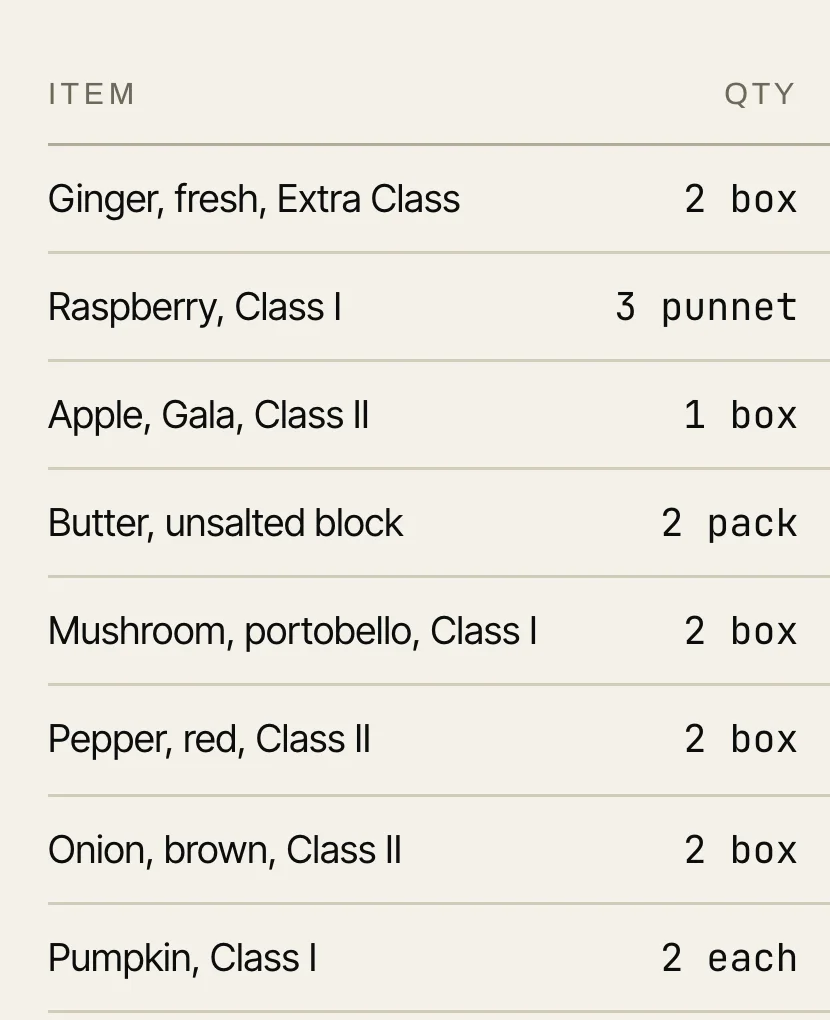
What an invoice is built from
What it replaces
Invoice runner replaces writing an invoice up from the delivery note by hand, then typing it again into the accounts package. The invoice is built once, from the proof, not copied twice.
What it works with
- Proof of deliveryEvery invoice is built from what was proved at the door.
- Price setterThat customer's price is applied automatically at the moment of invoicing.
- XeroThe finished invoice is handed to Xero or a similar accounts package. It does not replace it.
- Money chaserAn overdue invoice raised here is what the chaser works from.
Plainly
What it will not do on its own
- It does not invoice ahead of delivery. There is no invoice until the drop is proved.
- It will not average a catch-weight line to save a step. It invoices the weight that was actually picked.
- It does not replace your accounts package. It raises the invoice and hands it to Xero or similar, and stays beside it.
- A stale cost is never used to invoice. A price older than 48 hours is labelled, not treated as current.
What it replaces
Writing an invoice up from the delivery note by hand, then typing it again into the accounts package.
Time it saves
Say twenty invoices a day, each one built and checked by hand. A few minutes each is the best part of an hour that is no longer spent.
Worth in money
Say that hour is an office wage of £13 an hour - roughly £13 a day back, or close to £80 across a six-day week, on invoicing alone.
Questions people ask
- What is a catch weight?
- A catch weight is the actual weight of a product sold by the piece but priced by the kilo - a box of fish or a side of beef - and it varies box to box. Invoicing on the nominal or averaged weight instead of the actual one is how a wholesaler loses margin silently on every catch-weight line.
- Does invoice runner replace an accounts package?
- No. It raises the invoice from the delivered order and sends it to Xero or a similar package - the accounts package stays exactly where it is.
- Can an invoice be raised before delivery is proved?
- No. The invoice is built from the proof of delivery, so nothing is billed for a drop that has not happened.
- Who decides an invoice actually goes out?
- A person does, every time. Invoices assemble themselves from the day's proved deliveries, but nothing is sent until someone releases the day.
Give us one night.
Send us one evening's orders. We run the night next to you. In the morning you compare the two.