Features
Custom built
Built around one wholesaler's own pack sizes, prices and delivery rules. Not a template.
Custom built means the software is built around one wholesaler's own pack sizes, pricing arrangements, delivery rules and rounds, rather than asking the business to fit a template built for nobody in particular. One wholesaler's own history held 317 live pricing arrangements and 81 delivery rules that no template would ever have held a field for.
Off-the-shelf makes a wholesaler change to fit it: pack sizes, pricing arrangements, delivery rules, rounds, squeezed into fields built for nobody in particular. Custom built does the opposite - it changes to fit him. One wholesaler's own four years, put into one system, held 317 live pricing arrangements and 81 delivery rules a template would never have had a field for.
See the full case for custom against off-the-shelf, including where off-the-shelf genuinely wins, on the comparison page.
How it works
- 01The wholesaler's own flow gets mapped first: how orders actually arrive, how the round is actually built, what a price actually depends on. Not a demo of a fixed product.
- 02The software is built to that flow's pack sizes, pricing arrangements and delivery rules, including the ones that would never fit a dropdown.
- 03Nothing changes on the customer side. They keep ordering exactly as they always have, on WhatsApp, while everything behind it changes.
- 04It ships, and it keeps changing as the business does. A new pricing arrangement or a new delivery rule is a change to the software, not a workaround around it.
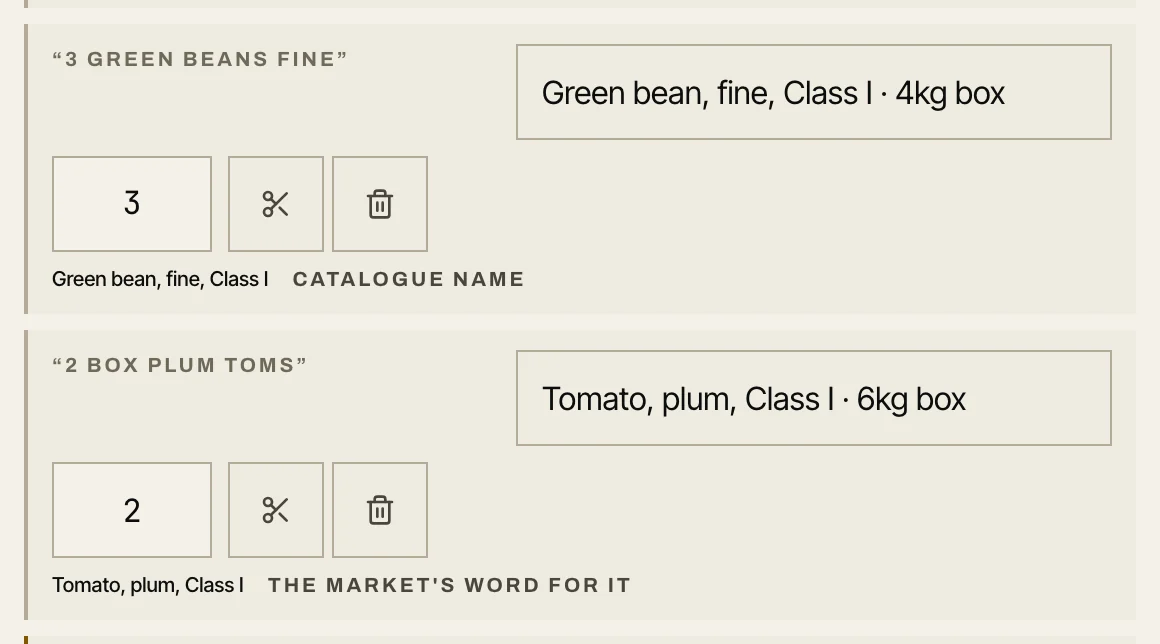
What a built-to-your-words order line looks like
What it replaces
Custom built replaces bending the business to fit a template's pack sizes, price tiers and delivery calendar, one workaround at a time. The software is built to the business instead.
What it works with
- Order takerBuilt to read the words this wholesaler's own customers actually use.
- Price setterHolds every pricing arrangement a template would never have had a field for.
- Route plannerBuilt to the delivery rules a wholesaler actually runs, not a generic set.
Plainly
What it will not do on its own
- Custom costs more to start than signing up to an off-the-shelf product, and it is not live tomorrow.
- It only pays for itself if the business actually has the complexity a template cannot hold - a small, simple book may be better served off-the-shelf.
- Nothing ships until the wholesaler's own flow has been mapped; a build starts with a night of real orders run alongside what he does now, not a demo account.
What it replaces
Bending the business to fit a template's pack sizes, price tiers and delivery calendar, one workaround at a time.
Time it saves
Not a minutes-a-night saving - a workaround you would otherwise be living with, every day, for as long as the template runs.
Questions people ask
- What makes wholesale software 'custom' rather than off-the-shelf?
- It is built around one wholesaler's own pack sizes, pricing arrangements, delivery rules and rounds, rather than asking the business to fit a template built for nobody in particular. The software changes, not the wholesaler.
- Is custom wholesale software more expensive than an off-the-shelf product?
- It costs more to start and is not live tomorrow. That is where off-the-shelf genuinely wins - the full case for each is set out on the comparison page.
- Who is custom wholesale software actually for?
- A wholesaler whose pricing, delivery rules or customer arrangements have grown past what a template was built to hold, which is most wholesalers above a certain size, and is the point where an off-the-shelf product starts costing more in workarounds than it saves in setup.
- Does the customer side change with a custom build?
- No. Restaurants keep ordering exactly as they do now, on WhatsApp - the custom part is entirely on the wholesaler's side.
Give us one night.
Send us one evening's orders. We run the night next to you. In the morning you compare the two.