Wholesale software
Bought at four. Worth less by nine.
Fruit and veg wholesale software has to know what most software never sees: the price moves by the hour, the grade is not a suggestion, and the box is losing value on the way to the van.
Fruit and veg wholesale software prices produce against the cost bought that morning. It keeps Class I and Class II as separate lines, never matched across each other, and invoices catch-weight boxes on the actual weight delivered - not a nominal one. Market Run does this daily, against one wholesaler's own market book, bought at four and moving by the hour.
Generic wholesale software treats a product as a fixed thing with a fixed price. Fresh produce is neither. The same catalogue line can cost three different amounts in a week, depending on which trader it came from and what the weather did. A box bought at four in the morning is already worth less by the time the first van leaves. Software built for produce has to carry that fact, not average it away.
What produce needs that generic software misses
- 01Today's market cost feeds today's buy - not a price list written last month. A price older than 48 hours is never shown as live.
- 02Class I and Class II are held as separate catalogue lines, start to finish. A match is never offered across them, so a customer who ordered Extra Class is never quietly filled with Class II.
- 03A catch-weight box invoices on the weight it actually carried out of the warehouse - never an average taken across a batch.
- 04Stock that is losing value by the hour is picked first-expiry-first-out, not in the order it happened to arrive.
- 05Twenty-seven traders sit behind one wholesaler's own book, each carrying their own current cost against the same catalogue line.
The kitchen's word, matched to the market's grade
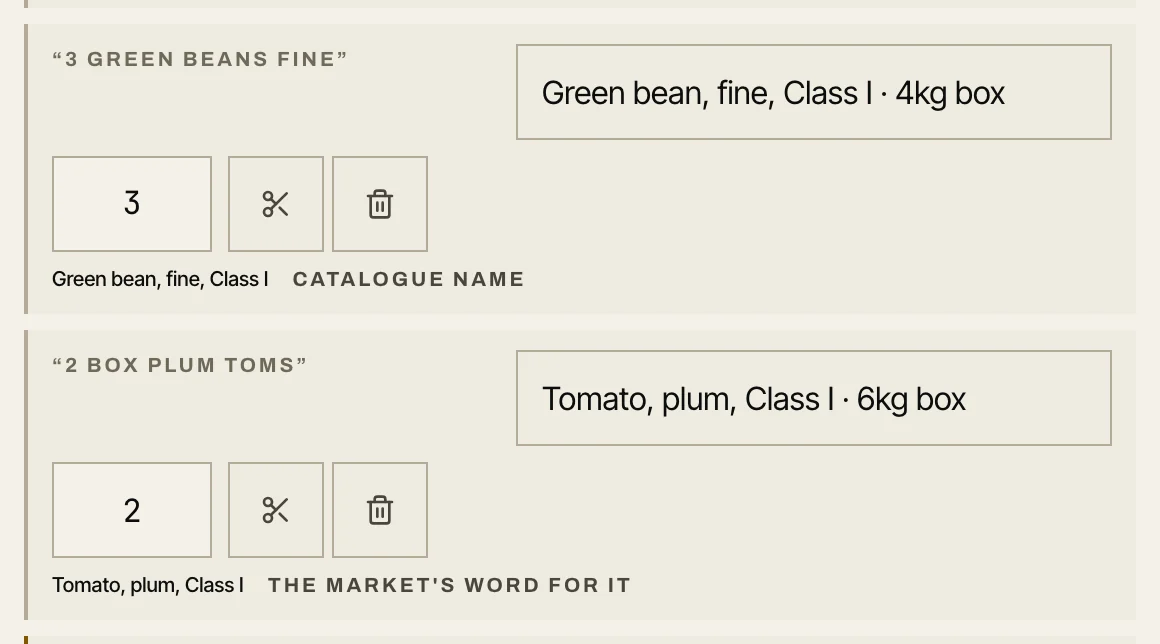
Plainly
What it will not do on its own
- It does not set Class I or Class II standards. Those are the market's own grading, applied to the catalogue - not invented by the software.
- It will not average a catch-weight line to make the sums simpler. It invoices on what actually left the warehouse.
- It does not buy the produce for you at the market. It prices and matches what your own traders sell you that morning.
- A product it has never seen is never guessed at a grade. It is held back on the order for a person to name.
Read next
Questions people ask
- What is fruit and veg wholesale software?
- It is software that prices produce against the cost bought that morning, not a fixed list. It keeps Class I and Class II as separate lines that are never matched across each other, and invoices catch-weight boxes on the actual weight delivered - never a nominal or averaged one.
- Does it keep Class I and Class II apart automatically?
- Yes. The two are held as separate catalogue lines, and a match is never offered across a grade tier. A customer who ordered Extra Class is never quietly filled with Class II because it was cheaper or more available that morning.
- How does it handle catch weight?
- A catch-weight product is invoiced on the weight it actually carried when it left the warehouse. That weight is captured at goods-in and again at the pick - never a nominal figure or an average across a batch.
- Does the price actually update every day?
- Yes. Cost is read from that morning's market buy. Any price older than 48 hours is never shown as live - it is labelled stale instead.
Give us one night.
Send us one evening's orders. We run the night next to you. In the morning you compare the two.