Features
Buy list
Rolls every order into one purchase list for the day, split by supplier, automatically.
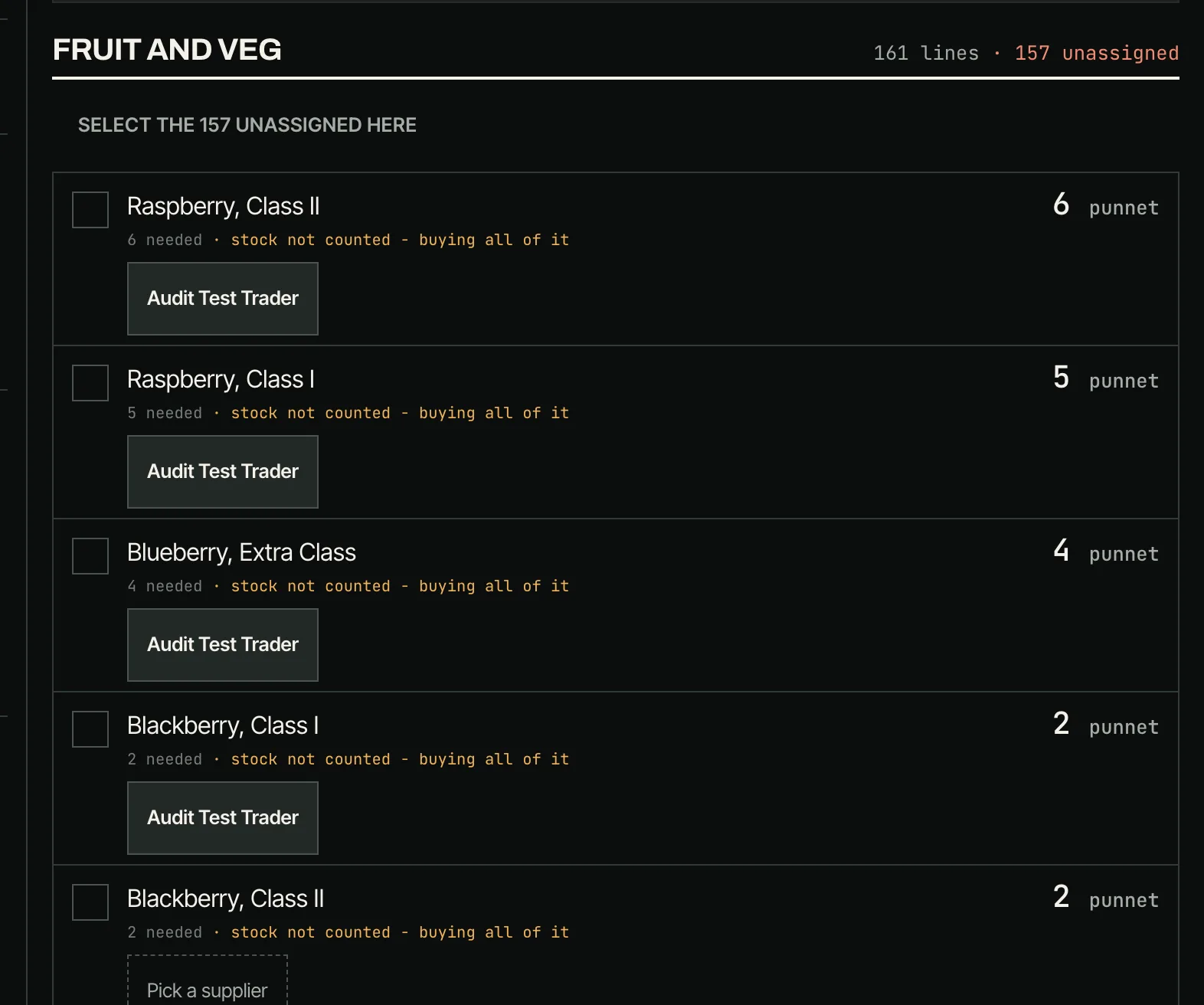
Buy list adds up everyone's orders into one list, split across the suppliers who actually carry each line. It builds this from the day's priced orders, checks it against known stock, and records what was actually paid from a photographed trader's docket.
A buyer at the market is working from memory and a stack of small orders scrawled on paper. One list, added up per product before he leaves the unit, is the difference between a walk round the market and a plan for it.
How it works
- 01Every priced order for the day rolls up into one buy list, added per product rather than per customer.
- 02Lines are grouped the way the buyer actually walks the market, and split across the suppliers who carry each one.
- 03What is already sitting in the cold store comes off the list before it is bought again.
- 04A trader's docket, photographed at the market, sets the cost that prices the day. No retyping a paper slip back at the unit.
- 05Cross-grade swaps never happen on their own. Class II is never quietly offered where Extra Class was ordered.
What one day's buy list looks like
What it replaces
Buy list replaces six phone calls, or a stack of scrawled paper orders added up by hand at the market. One list does the adding up before the buyer even leaves.
What it works with
- Order takerEvery priced order for the day feeds straight into the list. Nothing is typed in twice.
- Stock countWhat is already held comes off the list before it is bought again.
- Supplier messagesOnce the list is split by supplier, each trader's share becomes a ready-to-send message.
- Margin watchThe cost recorded from a docket here is the cost margin is measured against.
Plainly
What it will not do on its own
- It does not choose your supplier for you on price alone. Grade, reliability and the relationship stay a person's call.
- It will not read a paper docket by itself. Someone still photographs it at the market.
- It does not manage a supplier's own stock or delivery promise. It records what they actually sent.
What it replaces
Six phone calls, or a stack of scrawled paper orders, added up by hand at the market.
Time it saves
Say thirty customer orders roll up into one list instead of being added up by hand at 4am - the best part of half an hour back before the buyer has even left the unit.
Worth in money
Say that half hour is a buyer's wage of £13 an hour - a bit over £6 a morning, about £35 across a six-morning week, just for not adding the list up by hand.
Questions people ask
- What does a buy list do for a wholesaler?
- It adds every customer's order into one list, split across the suppliers who carry each line. It becomes the purchase, or the market run, a buyer actually executes, instead of totting it up by hand.
- Does it work with more than one supplier per product?
- Yes. A line can be split across two or more suppliers, and the list shows what each one is being asked for.
- How does the actual cost get recorded?
- From a trader's docket, photographed at the market. That figure sets the cost behind pricing and margin for the day, not an estimate.
- Does it replace choosing which trader to buy from?
- No. It builds the list and keeps the history - which trader, at what price, how reliably - but the choice on the day stays with the buyer.
Give us one night.
Send us one evening's orders. We run the night next to you. In the morning you compare the two.