Bespoke software
It worked in the demo. Week two is where a template runs out of room.
For a wholesaler who has already signed up to something and gone back to WhatsApp and a whiteboard for most of the book. Here is exactly why.
An alternative to off-the-shelf wholesale software is one built around a wholesaler's own book rather than a shared template. A template usually fails on four things: pack sizes that vary by customer, per-customer pricing arrangements nobody wrote down, delivery days that are not the same for every customer, and grade tiers a dropdown was never built to separate.
Off-the-shelf ordering software is not wrong to exist - it is fast to start and cheap on day one, and for a simple book it can be the right answer for years. The problem shows up in one place: the fields it offers were designed for a generic wholesaler who does not exist, and a real book collects exceptions the fields cannot hold. A 10kg box for one customer, a 5kg box for another, a catering pack for a third, all of the same product - most templates want one unit per product, not one per customer.
The pricing arrangement is the same problem in a different shape. Somewhere in most books is a customer who has had a fixed price since a conversation three years ago that nobody wrote down, and a template has no field for "because we agreed it". Delivery days are the third problem: not every customer gets every day, and a template that assumes one shared delivery calendar turns a real exception into a manual note that eventually gets missed. Grade tiers are the fourth, and the sharpest - Class I is not the same product as Class II, and software that cannot tell them apart risks the wrong one going out the door.
The signs a template has run out of room
- 01A price gets overridden by hand most nights, because the arrangement this customer has is not the one the software was set up with.
- 02A pack size does not exist in the dropdown, so it gets entered as the nearest one, and the invoice is quietly wrong.
- 03A customer's delivery day is 'usually Tuesday, sometimes Thursday if the order is small', and there is no field for that - it becomes a note nobody reads.
- 04A grade substitution - Class I for Class II, or the other way round - has to happen outside the system, because it was never built to tell the grades apart.
- 05Exceptions start outnumbering the orders the software actually handles cleanly, and the team goes back to WhatsApp and a spreadsheet for most of the book.
Order matching kept in your own words
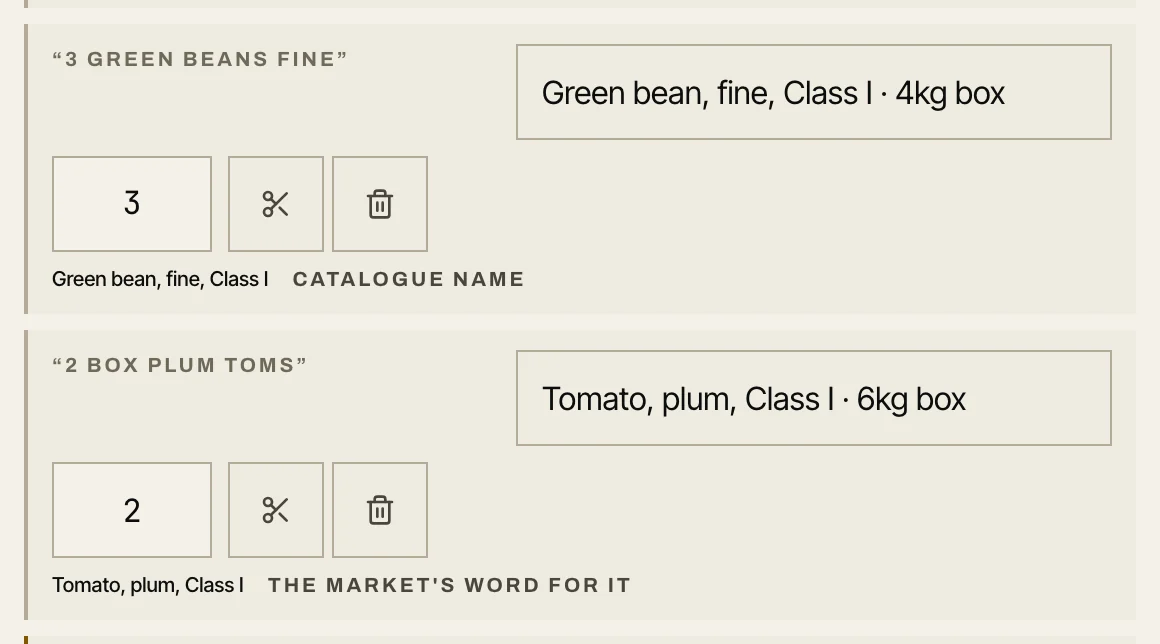
Plainly
What it will not do on its own
- This is not a claim that every off-the-shelf product fails every wholesaler - a small, simple book with standard pricing can be genuinely well served by one.
- A custom-built alternative costs more to start and takes longer to go live than signing up to a template.
- Moving off a template mid-year usually means running both systems for a while until the new one is proven, not switching overnight.
Questions people ask
- What is an alternative to off-the-shelf wholesale software?
- It is software built around one wholesaler's own book, rather than a template shared across every customer of that product - its own pack sizes, its own per-customer pricing arrangements, its own delivery days, and its own grade tiers, instead of the fixed fields a template was built with.
- Why do wholesalers abandon off-the-shelf ordering software?
- Usually for the same handful of reasons: pack sizes that vary by customer and do not fit one dropdown, pricing arrangements agreed years ago that were never written down anywhere a template could hold them, delivery days that are not the same for every customer, and grade tiers the software cannot tell apart.
- What is a grade tier, and why does it matter here?
- A grade tier is a quality class within one product - Class I against Class II, or Extra Class against Class I. A template usually treats these as substitutable, or does not model them at all, which risks a lower grade going out against an order for a higher one, or the reverse.
- Is switching away from a template worth it?
- It is worth it once the exceptions have become most of the work - when a price is overridden by hand most nights, or the team has quietly gone back to WhatsApp and a spreadsheet for the orders the software cannot hold properly. Below that point, a template can still be the right answer.
Give us one night.
Send us one evening's orders. We run the night next to you. In the morning you compare the two.