Ordering channels
A voicemail is still an order. It gets read the same way.
A voice note left at ten and a message left on the answering service at midnight both become the same thing: a priced line, or a question, on the same thread.
Voice order capture transcribes a voice note into text and matches it against the wholesaler's own catalogue, exactly as a typed WhatsApp message is matched. Voicemail order processing does the same for a message left on the answering service overnight. Anything the catalogue has never held is held back for a person to name rather than guessed.
A kitchen porter with wet hands does not type. A head chef driving home leaves a voice note instead of stopping to write one. Neither order is worth less than a typed one, and neither is treated as a special case - both go through the same transcription, the same catalogue matching, and the same rule that anything unclear is asked about rather than assumed.
How it works
- 01A voice note arrives on WhatsApp, or a voicemail is left on the number the wholesaler already answers orders from - both usually overnight, when nobody is there to pick up.
- 02The recording is transcribed to text, the same as if the customer had typed it.
- 03That text is matched against the wholesaler's own catalogue, using the words the kitchen actually said - a local name, a half-finished sentence, a quantity with no unit.
- 04That customer's own pricing applies automatically, exactly as it would on a typed order.
- 05Anything the catalogue has never held, or the transcription could not make sense of, is held in its own lane and asked about on the same thread rather than guessed.
- 06The priced order joins the buy list, the picking sheet and the round, alongside everything that arrived by text.
What it looks like when a line cannot be placed
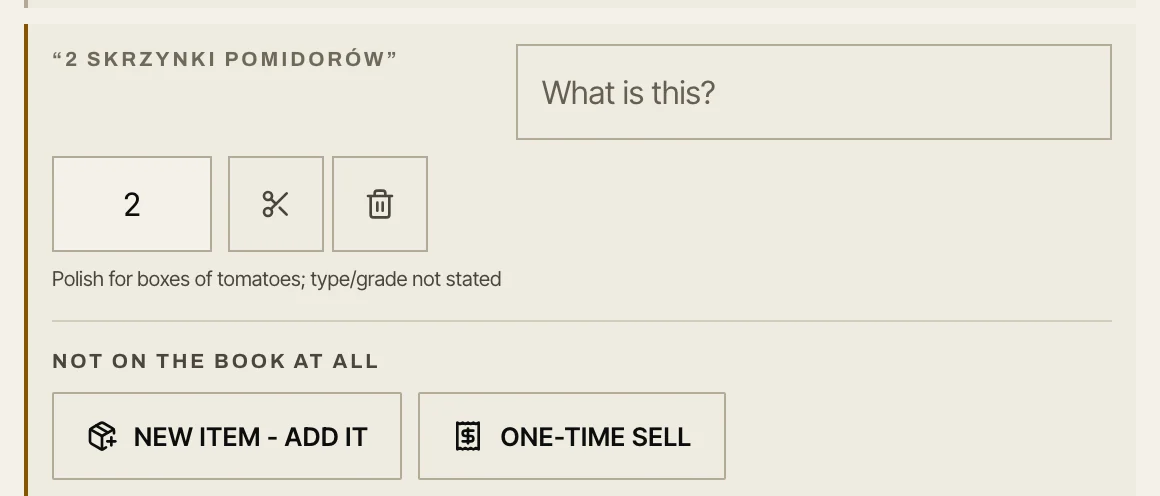
Plainly
What it will not do on its own
- It does not call a customer back to ask what they meant - a held-back line is asked about on the same thread when someone reads it.
- A poor recording, a lot of background noise, or a strong local accent the transcription has not seen before can produce a line it cannot place; that goes into the held-back lane, not a guess.
- It reads voicemail left on the number already used for ordering - it does not run or monitor a separate phone system.
- It will not guess a product a voicemail describes that the catalogue has never held - it asks, the same as it would for a typed message.
Questions people ask
- Is a voice note read differently from a typed message?
- No. A voice note is transcribed to text first, and from there it goes through exactly the same catalogue matching, customer pricing and held-back lane as a message someone typed. It is not treated as a lesser or riskier source than text.
- What happens to a voicemail left overnight?
- It is transcribed and matched against the wholesaler's own catalogue the same way, so an order left on the answering service at midnight is ready as a priced line by the time anyone is in to check it, with anything unclear held back and asked about.
- What if the transcription gets a word wrong?
- If the resulting text cannot be matched against the catalogue with confidence, the line is held back and asked about on the same thread rather than being guessed at and shipped wrong.
- Does this replace someone listening to voicemails?
- It replaces someone listening to a voicemail and typing it in by hand. Anything the system could not place still needs a person to read the held-back lane and answer it.
Give us one night.
Send us one evening's orders. We run the night next to you. In the morning you compare the two.